Well, there is not much news to report this week. Spring is coming quickly to South West Saskatchewan. We went from -41 degrees Celsius on March 1, to 12 degrees less than two weeks later. Fortunately, I would say our snowfall this winter was average to good, but not extreme, otherwise there could be tons of water and flooding issues with the melt happening this quickly. It still could happen, but I am not anticipating the flooding that happened two years ago.
In terms of building, I contacted Future Steel Buildings to arrange a date for delivery of my building. I misunderstood here, thinking that it was up to me to arrange a delivery date. It turns out, that was only if I wanted to take early delivery of the building. Future Steel does offer a 50 dollar incentive in the form of a gas gift card to anyone that can take early delivery. I guess it helps them to move out inventory and clear up floor space in their warehouses. Unfortunately I could not realistically have the building delivered in March with spring barely emerging. Delivery would have to be in April. I would have even preferred to have it delivered after I have the foundation done but that can’t happen without incurring further charges.
So for now, I am in a bit of a holding pattern. There are a couple of decisions I have to make in the coming week:
1. How do I want to finance the remainder of the building? Future Steel wants payment by certified cheque or bank draft upon delivery. Since I deal with ING direct, it might take a little while for a draft to arrive.
2. I have to decide if I want to install Flextherm’s Green Cable Concrete. There are no local dealers for this product. I would have to order it from Regina and even at that it might take a bit of time to arrive. I am anticipating (hoping) that the foundation will be done in May
3. Storage – Future Steel informed me that my building will arrive on two skids that will take up 4 X 12 X 3 cubic feet of space. They said that it could be stored on a deck and covered with a good tarp. I am going to double check again to make sure that our deck will hold up to that much weight. My first reaction was “no problem” but then it hit me that that is the entire building on my deck. Double checking is a good idea.
I am a teacher by trade, and am blessed to be able to have meaningful work to do on a daily basis. Having grown up on a farm however, I am looking forward to the physical nature of this project while at the same time sharing (and teaching) my story.
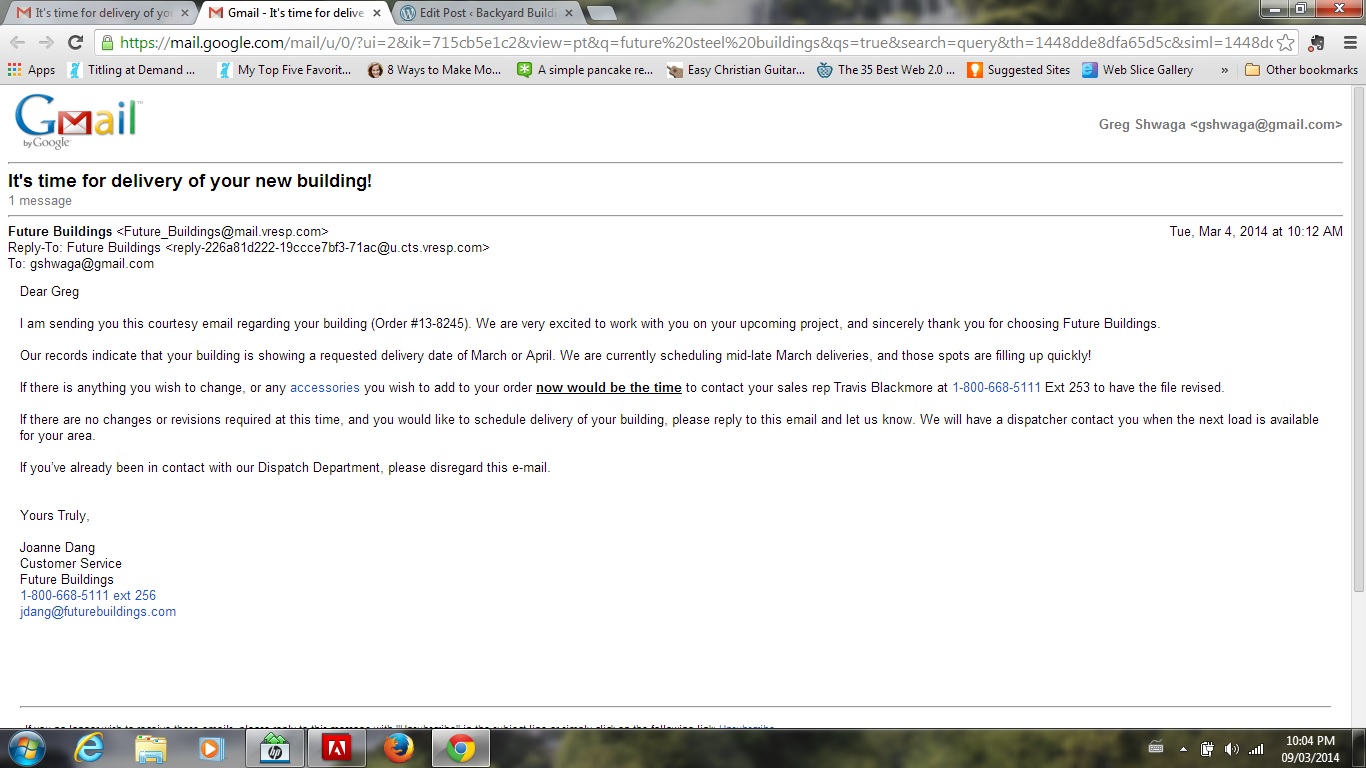
Fortunately, today the weather turned and it was a pleasant 8 degrees Celsius outside. Spring is coming and so is the building. My understanding is that I have to have at least four people to help me unload the thing and also a certified cheque ready to pay the driver the balance of what I owe.
Unfortunately, I will have to store the building outside until I can actually work on it. That will take some time. I would prefer to have it stored inside, but then again, if I had a building in which to store my building, then I wouldn’t need a building.
I also contacted Mr. Joel Funk from Strong Built construction in Wymark, Saskatchewan. He will be coordinating the the pour of the concrete pad foundation. This will hopefully take place early in May, when the ground is thawed and construction can commence.
I am toying with the idea of putting in floor heating but having a boiler/manifold system seems to be a little complex for my liking. I have found another system however that simply employs electric heating cable (instead of hoses) embedded in concrete. Made by a company called Flextherm in Quebec, the product is called Green Cable Concrete. Here is a link to the company’s website:
Flextherm – Green Cable Concrete
Does anyone have any experience with this product? Your feedback would sure be welcome.
This project is heating up; just like the weather.
Thank you for your response. ✨

No going back now!
Once you order your building from Future Steel Buildings, an agreement is signed and you are asked to place a deposit using a credit card. Although I understand the reason, this part of a transaction has always been a bit disconcerting for me. Your credit card is billed but the product you are purchasing is months away from being delivered. Anyway, with that done, I jumped into this building project with both feet. A few days later, this arrived in the mail:

So with pieces of a steel structure that will become my garage/shop to be here in April; it was time to decide upon a foundation!
The default foundation for a Future Steel Building of this type, is a basically a concrete footer around the perimeter that is 8 inches wide and 18 inches deep. Along the length of the building, the footer is poured with a “u” channel into which the steel arches are placed. The arches are then anchored inside the channel using angle iron every two feet and then grouted over top. Inside the perimeter of the foundation, your floor can be anything from dirt to crushed rock or pea gravel, or, you can pour a concrete floor later.
I don’t think so!
While certainly cheaper, I could see within about five minutes, that this is not the foundation that I wanted. First off, I think building the forms for the “u” channel would be a pain. Secondly, grouting over top of the steel arches would effectively make the structure permanent, and I wanted the option of moving the building if need be. Third, any mistake or miscalculation here means the building doesn’t go up straight and true. Fourth, it seems to me that any mistake or breakdown in the grouting means that water is going to get into your building and I don’t want that. Finally, this option still left me without a floor.
So, after some, but not much deliberation, I called Future Steel Buildings and told them that my intention was to put this building on a concrete pad. To do this, I also had to order the portable steel base plate connectors. This was an extra cost; however, I feel that this is a much better foundation option for a steel arch structure. Basically, the steel base plate connectors bolt to the concrete pad along the length of the building. The steel arches of the building then fit and bolt to the base plate. Water can’t get into the building because it can’t get past the plate. Also, the plates are engineered to fit the arches so theoretically, if I put the plates onto the concrete pad properly, the building should go up straight and true. Also, theoretically, if I want to take down the building, I just have to unbolt it from the plate, and unbolt the plate from the pad. True, if that ever happens the concrete pad is a waste, but the way I see it, concrete is gone as soon as it hits the ground.
I spent a few days thinking and researching into excavating and pouring the pad myself. After all, I grew up on a farm and had done some concrete work as a kid pouring pads for grain bins and so on. I was feeling confident that I could accomplish this, when my step dad told me that I was crazy. He suggested that I find someone that was “good” at concrete work (obviously pointing out that I am not) and make sure that it gets done properly. Given that I don’t have any excavating equipment and the time that it would take for me to do the prep work I decided to take my step dad’s advice; a concrete pad formed and poured by a professional it is (cost is going up!).
Thank you for your response. ✨


 Backyard Building