My concrete pad was poured the third week of May. Being a school principal, the end of May coincides with the beginning of the busiest time of a busy year. I knew would have to wait until July to begin building my steel garage. School would require all of my attention in June. I did have a rough timeline in mind:
July:
1. Attach base plates
2. Assemble arches
3. Erect arches
4. Frame and insulate end walls
5. Backfill with 7/8 washed gravel
August:
1. Insulate building
2. Wiring
3. Install garage doors
The Decision to use Base Plates
You can save on the overall cost of a steel building by not ordering base plate connectors. Base Plate connectors are simply a steel plate 7-10 inches wide that attaches to your concrete footer or pad via embedded bolt or expanding concrete anchors. If you opt not to use base plate connectors, you have to create a “u” channel in your concrete at the time of pouring. Your steel arches then fit into this channel and attach to the concrete via a piece of angle iron. You must also grout over top of the base of the arches once embedded into the “u”channel. I didn’t like this set up for the for the following reasons:
1. Added complexity at the time of pouring concrete. It seemed to me that framing for and creating the “u” channel would be an annoyance and probably end up costing more in labour at the time of pouring the concrete pad.
2. The “u” channel would have to be perfect. Otherwise, the steel arches would be wonky.
3. Grouting after the fact would be a pain and not likely as waterproof as the steel base plate connectors.
4. Moving the building or reconfiguring the building would be much easier with the base plates rather than the permanent grouting of the steel arches.
Installing the Base Plates
Installing the base plates was simply a matter of laying out the plates on the concrete pad, ensuring that they were square on the foundation and then drilling the anchor holes. Squaring up the plates was accomplished by cross measuring across the foundation and making sure that the measurements were the same. I also used a transit to double check my straight lines. After putting the base plates in position, I took a vertical line with the transit just to make sure that what I thought was straight was actually straight.
Drilling holes in the concrete was problematic at first. I had a Dewalt hammer drill and concrete bit but discovered upon drilling my first hole that I couldn’t even drill one hole let alone the 82 that were required. Each 1/2 hole had to be drilled to 4.5 inches depth and then anchor bolts installed. As I researched my problem with drilling holes in concrete, this video surfaced.
It was clear that I needed a rotary hammer drill. I made a couple of calls, rented one for a week and drilling the holes for the anchor bolts turned out to be quite easy. Just an FYI, I should have purchased a rotary hammer drill. The cost for renting one for a week turned out to be similar to purchasing a new one.
The drills to the left are hammer drills. They are completely useless for drilling into concrete. The drill to the far right is the rotary hammer drill that I rented. It made drilling into concrete as easy as drilling into wood. Another technique that is absolutely necessary when drilling into concrete, is that you have to use your shop vac and air compressor and vacuum and blow out each hole.

With that, I put the base plates down, drilled 82 holes and dropped in 5.5 inch 1/2 inch bolts. A little tip here is to use two nuts on each bolt. You will squash the bolt as you pound it into the concrete. If you only have one nut, it may not travel all the way down the threads to tighten properly. I suggest putting one nut near the bottom and another at the top, even with the threads. Pound the bolt in using the first nut and then tighten the anchor using the nut at the base. You can then spin the top nut off using an impact wrench or cut it off if the bolt is damaged. According to manufacturer recommendations, each anchor bolt was then tightened to 60 foot pounds using a torque wrench.
Please note that Future Steel Buildings does not supply anchor bolts. This an added cost and 82 bolts of that size will run you around 300 dollars. Ouch!
Here is the pad with the base plate connectors attached. You can see them along the side square and ready for attaching the arches. I also caulked along the bottom just to make it neater.
You might also notice the puddles of water. As good as the concrete job was, there were still places that were slightly lower as a result of the final trowelling job. There was one low spot exactly where the base plate connector needed to go. I had to cut some metal shims and insert them under the connector here in order to keep the base plate connector level.


With the base plate connectors in, I was ready for the arches.
Deciding on a foundation was not as easy I thought. The problem is that in our area concrete is well over 200 dollars per cubic meter. At that price, having a concrete pad for a garage immediately becomes about a third of the overall cost of the project. Building concrete footers with a gravel pad would have been cheaper but ultimately not very convenient for a heated garage. In the end, I decided to go with a concrete pad and industrial base plate connectors for the building.
Now, when I grew up the farm, I would have just gone to the shop started up the tractor and begun excavating. Not having access to that equipment means renting equipment or hiring someone. As much as I wanted this to be a DIY project, I decided to hire someone to do the concrete work. Also, growing up I always had access to gravel. We either had it stockpiled, or had veins of gravel that could be dug up somewhere on our farm. In addition to hiring someone to do the concrete, I had to find gravel.
I hired Joel Funk and Strong Built Construction from Wymark, Saskatchewan to excavate the site, build the forms and pour and finish the concrete. It turns out that there was an old garage on my build site that had about 4-5 cubic metres of gravel. I needed about 10 and was able to purchase 6 cubic metres from a stockpile that a farmer had in Vanguard.
Just prior to pouring the concrete, I had toyed with the idea of putting in-floor electric heating cable (embedded in the concrete) from a company called flex-therm. The company estimated that I would need about 7300 watts to heat the building and that the cost would have been around 2000 dollars for the installation. Before I made the investment, I had electricians come out to survey the site and put together an estimate for the later wiring of the building. When I asked about flex-therm, neither electrician had heard of the product. They were sceptical that it would heat the building but told me they would look into it. After a couple of days one of the electricians called me back and advised against flex-therm for this particular purpose. He didn’t think it would work as a primary heat source for a building this size and height in our climate. Needles to say, I didn’t take a chance on the flex-therm product this time. The upside was that I saved 2K, plus pouring the concrete pad was a much easier process.
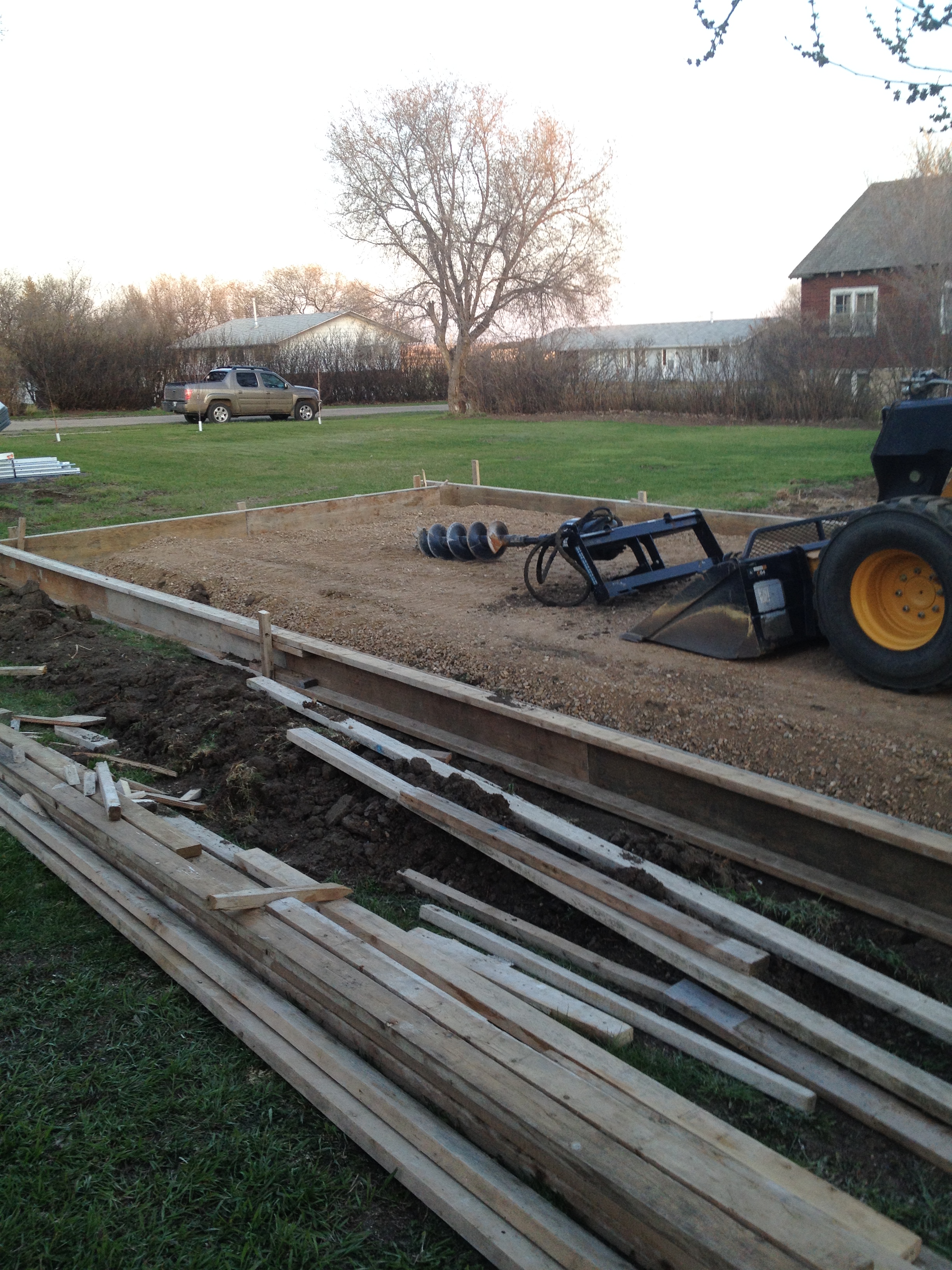
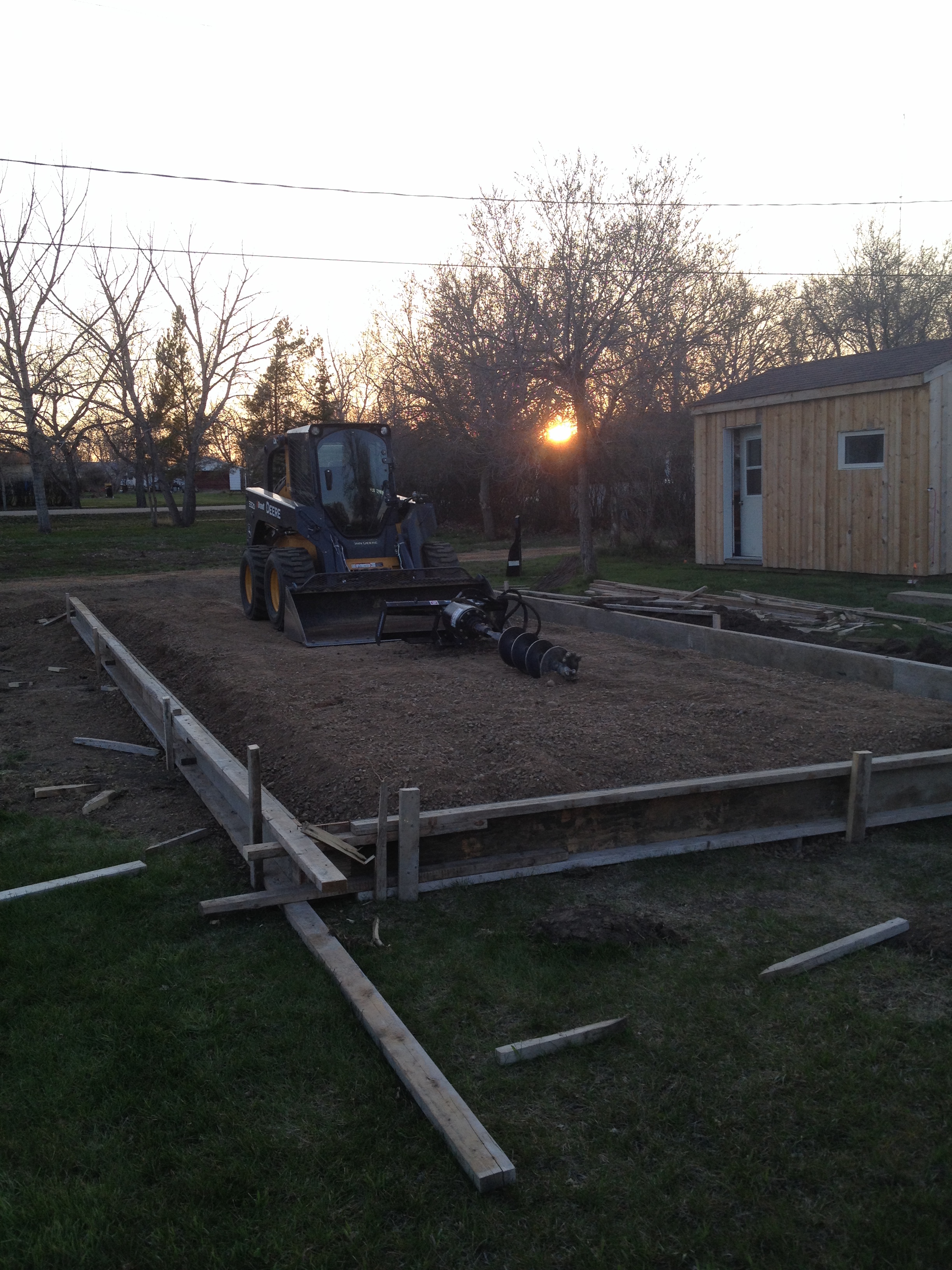
Excavation of the site began the second week of May. Gravel was hauled in, and forms built soon thereafter. After waiting for some sunny days in the forecast, the concrete arrived, was poured an finished. Unfortunately I didn’t get to see most of this process, as I was at work. One day, I came home and the pad was just there.
Here is what the process looked like.
Waiting for the concrete:
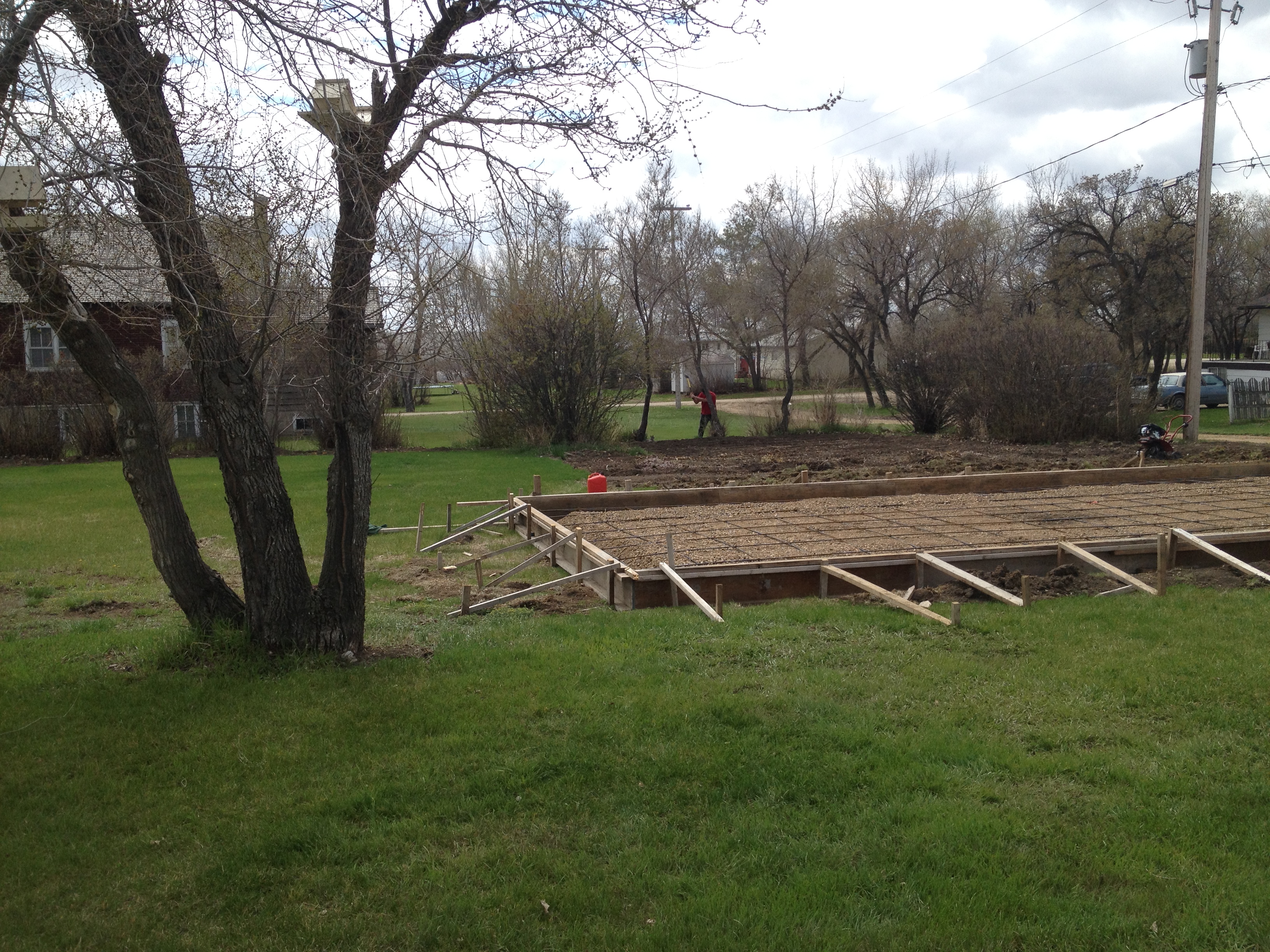
The finished pad.
Next: Baseplate connectors.


 Backyard Building